Turf to Habitat Conversions
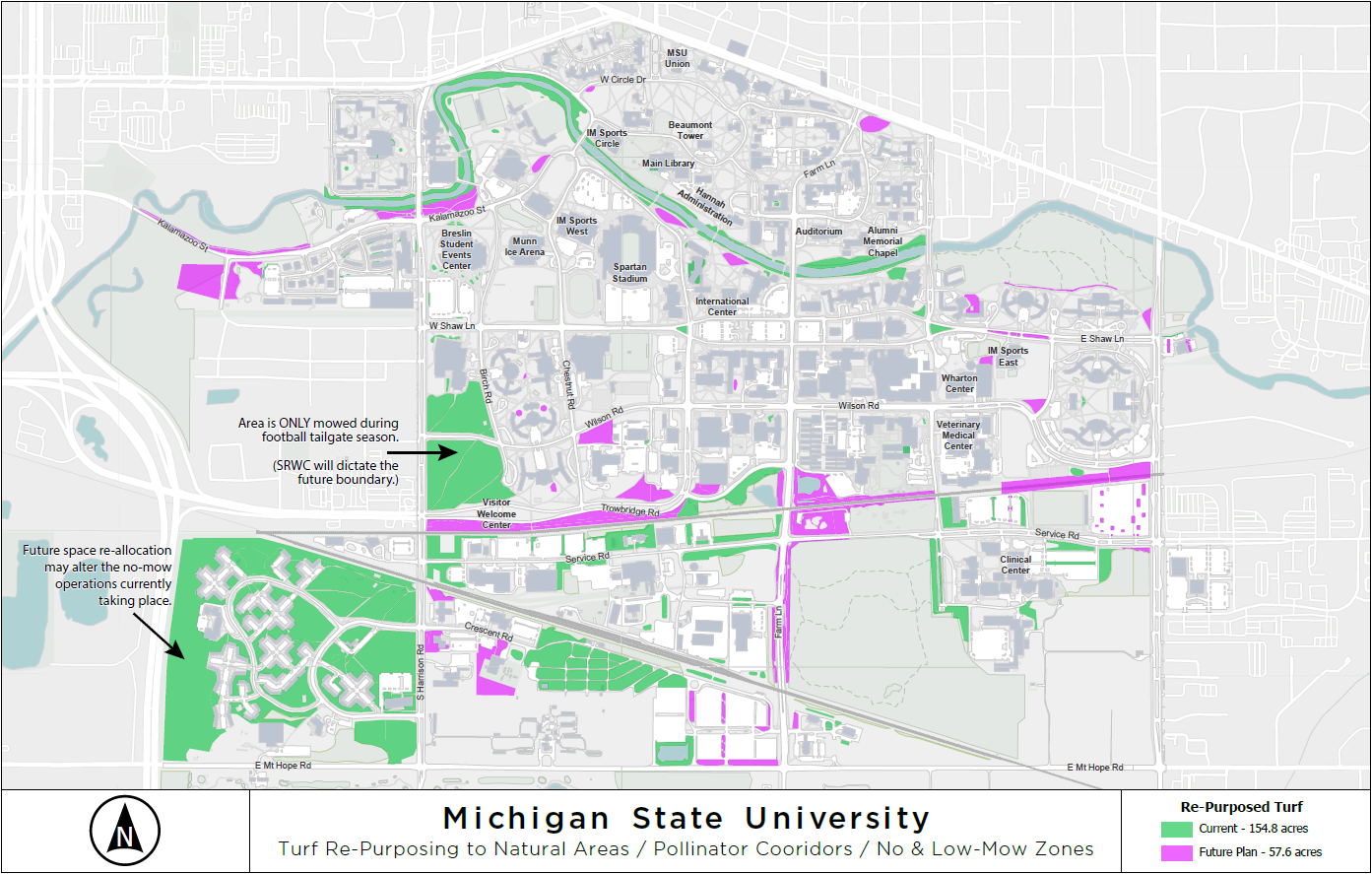
As of 2026, MSU's Landscape Services team has converted six acres of turfgrass into native pollinator habitat across campus. This first phase provides a clear framework - detailing effective methods, realistic outcomes, and lessons learned - to guide future projects and support MSU's growing network of pollinator-friendly landscapes.
Why MSU Made the Change
MSU maintains hundreds of acres of turfgrass - much of it is essential, but some is maintained simply out of routine. Beginning in late 2024, MSU Landscape Services Manager, Matt Bailey, and Landscape Services Coordinator, Josh Ridner, began evaluating the true costs and benefits of maintaining these low-use turf areas. They identified several locations that required weekly maintenance but provided little functional or ecological value.
Replacing these areas with native pollinator habitat offered a way to:
- Reduce labor and maintenance costs
- Supports MSU's Bee Campus USA commitments
- Respond to visitor requests for pollinator-friendly landscapes
- Model approaches that other institutions could replicate
Project Goals
- Convert low-use turfgrass into native habitat with minimal disruption
- Reduce labor costs
- Use existing budgets - no new funding necessary
- Test multiple preparation methods to guide future projects
- Improve aesthetics in high-visibility areas
Cost snapshot
Turfgrass maintenance is one of the most time- and resource-intensive tasks on campus, costing MSU about $1,100 per acre each year for mowing, trimming, edging, fertilization, and weed control. By reducing the acreage of high-maintenance turf, the team projected substantial savings over a five-year period – more than $74,000 compared to maintaining the same areas as turf. Instead of investing in weekly upkeep, existing funds could support habitat installation through seed, plugs, and labor already budgeted for the areas, and still save money.
Site Selection
Six sites were chosen based on:
- Low recreation use
- Manageable visibility and safety considerations
- Varied soil and weed conditions
- High potential for long-term maintenance savings
- No planned construction
These sites included a mix of high-visibility corridors, underused lawn areas, and narrow strips that were maintenance-heavy but offered little functional value. The team intentionally selected sites with varied soil conditions, weed pressures, and maintenance histories to test multiple preparation and planting methods. This approach would help determine what would scale effectively across the remaining 16 acres planned for future conversions.
Plant Selection
Plant selection was guided by compacted, clay-heavy soil conditions, bloom timing, visual appeal, and the need for low-maintenance species. Some species were chosen for specific microhabitats – dry, wet, or shady areas – while others were suitable across multiple sites. In total, the team purchased:
- 288 pounds of Native Connections’ Dry-Mesic seed blend
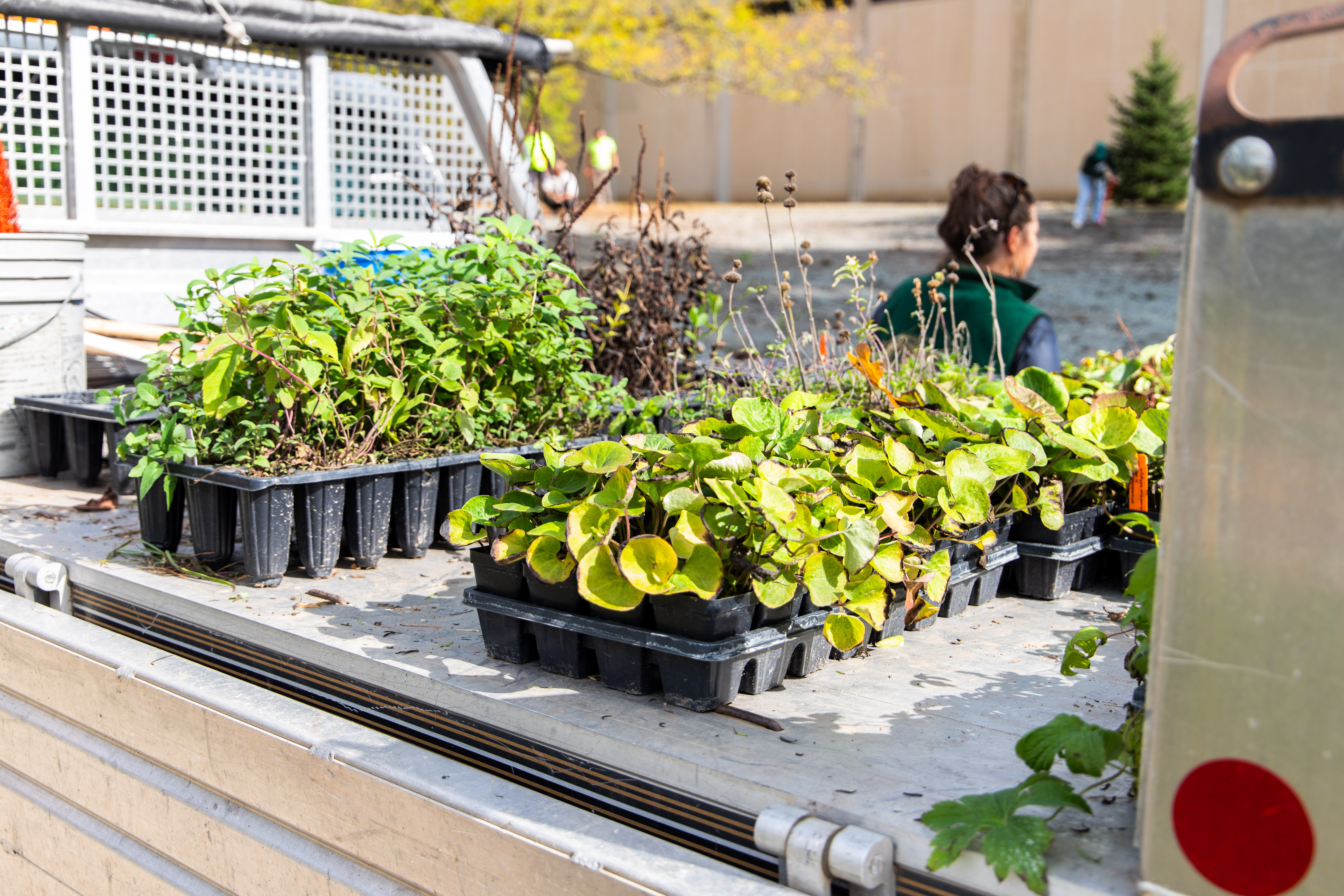
- 3,952 plugs from Wildtype Nursery
- Allium cernuum
- Anemone canadensis
- Asarum canadense
- Asclepias incarnata
- Asclepias tuberosa
- Carex bicknellii
- Coreopsis lanceolata
- Eupatorium perfoliatum
- Eutrochium maculatum
- Fragaria virginiana
- Geranium maculatum
- Iris virginica
- Liatris aspera
- Monarda fistulosa
- Monarda punctata
- Penstemon hirsutus
- Pycnanthemum virginianum
- Rudbeckia hirta
- Schizachyrium scoparium
- Silphium terebinthinaceum
- Solidago nemoralis
- Solidago rigida
- Sporobolus heterolepis
- Tradescantia ohiensis
- Veronicastrum virginicum
- Nodding onion
- Canada anemone
- Wild ginger
- Swamp milkweed
- Butterfly weed
- Bicknell’s sedge
- Lanceleaf coreopsis
- Boneset
- Joe-Pye weed
- Wild strawberry
- Wild geranium
- Southern blue flag
- Rough blazing star
- Bee balm
- Horsemint
- Penstemon
- Mountain mint
- Black-eyed Susan
- Little bluestem
- Prairie Dock
- Old-field goldenrod
- Stiff goldenrod
- Prairie dropseed
- Spiderwort
- Culver’s root
Seeds provided broad coverage for the large sites, while plugs ensured faster establishment and conveyed a more intentional appearance. Public perception was an important consideration, especially in highly visible areas. Plugs and pollinator habitat signage helped demonstrate progress while seeds took time to establish. Using both seeds and plugs balanced efficiency with aesthetics, creating a habitat that looked purposeful rather than neglected.
Site Preparation and Planting
The main challenges in preparation were the soil compaction and existing vegetation. The team tested multiple preparation strategies to determine what would work best for future projects. They initially planned to install plugs using dibble sticks, but compacted soils made this difficult. Switching to drill augers improved efficiency despite requiring additional labor.
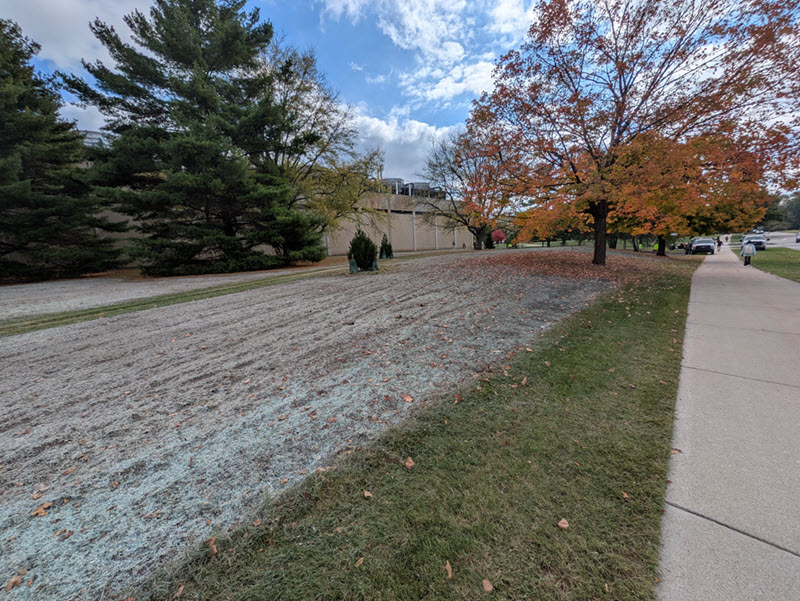
Below is a summary of each site’s preparation and planting strategy. Click on each site number to expand for additional details
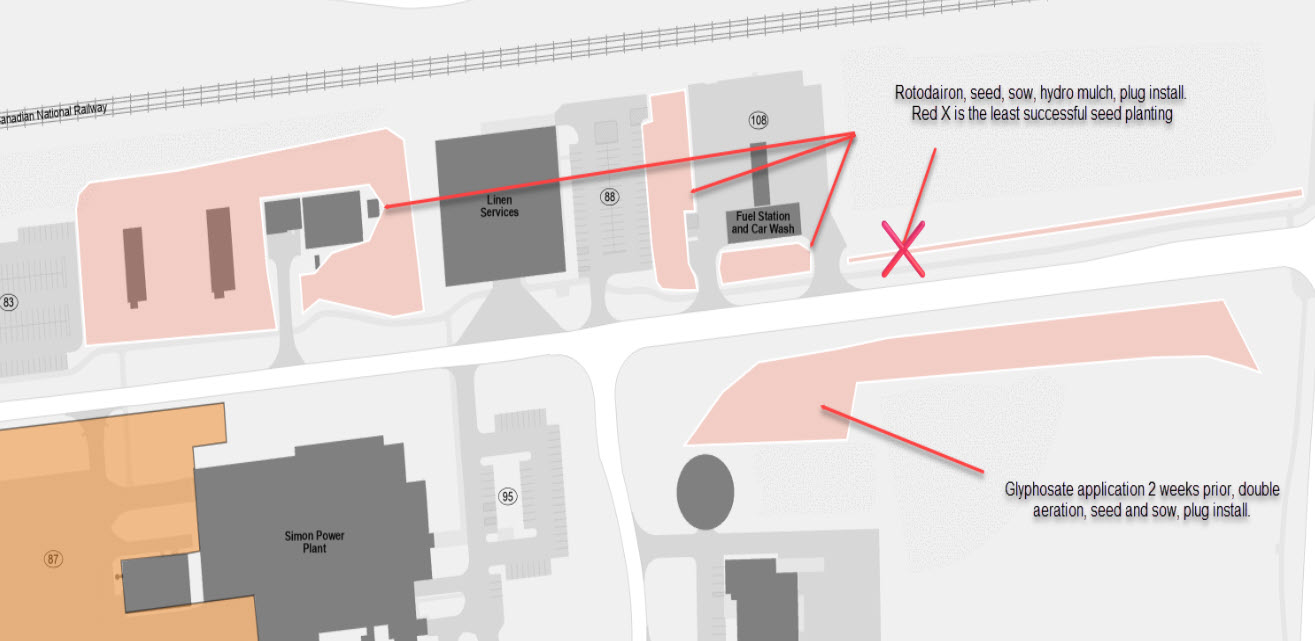
This narrow, highly visible strip runs along a sidewalk near MSU’s fuel station. It was not used for recreation or events, and its proximity to pedestrian traffic made it an ideal demonstration site.
Preparation & Installation (Early June)
- Rotadairon pass to loosen soil and prepare seedbed
- Seeds applied and covered with hydromulch (retain moisture and protect the seeds)
- No pesticide applications due to time constraints
- Mowed the area at 8 inches
Early Outcome
Despite seeing signs of the cover crop, echinacea, and partridge pea, the early summer dry and very hot weather allowed Bermuda grass to choke out the native seedlings. Plugs were not included due to the early poor performance of the site. For the upcoming season, Ridner plans to apply Ornamec to suppress Bermuda grass in hopes of rectifying the site.
These two sites shared similar conditions to Site 1 but had noticeably lower weed pressure.
Preparation & Installation (Mid June)
- Rotadairon pass
- Seeds applied and covered with hydromulch
- No pesticide applications due to time constraints
- Plugs were added in October (maintained in a shade house during hot weather)
- Structured plug layout in high-visibility areas; informal layout behind buildings
Early Outcome
Both sites established significantly better than Site 1. The plug installation added visual appeal and helped improve public perception of the ongoing project. These helped demonstrate that an early-summer seeding can thrive when weed pressure is minimal.
Located just across the street from Sites 1-3, this area served as a pilot for a different preparation method focused on herbicides plus aeration in the fall.
Preparation & Installation (Fall)
- Two applications of Ranger Pro herbicide using a boom sprayer
- Double core aeration to relieve compaction and improve seed-to-soil contact
- Seeds applied and sown
- Plugs installed in late fall
Early Outcome
This herbicide plus aeration approach proved to be highly effective in reducing weed pressure and improving establishment.

This small, contained, highly visible site allowed the team to test a plug-heavy approach and evaluate mid-summer installation under manageable conditions.
Preparation & Installation (Late June)
- Area was tilled
- Seeds applied and sown
- Four flats of plugs installed at the same time
- EZ-straw mulch applied to retain moisture
- Supplemental watering through June and July
Early Outcomes
This site produced strong early results with partridge pea and brown-eyed Susan blooming early. Consistent watering and mulch protection helped the planting thrive despite hot, dry weather.
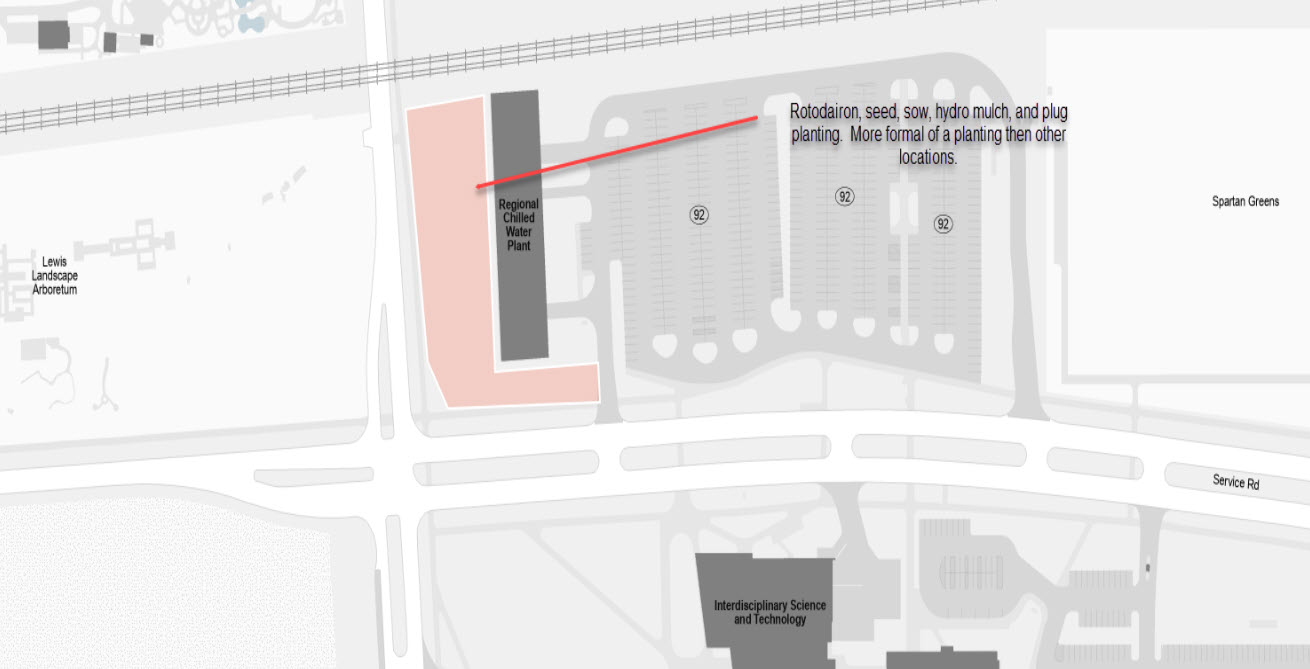
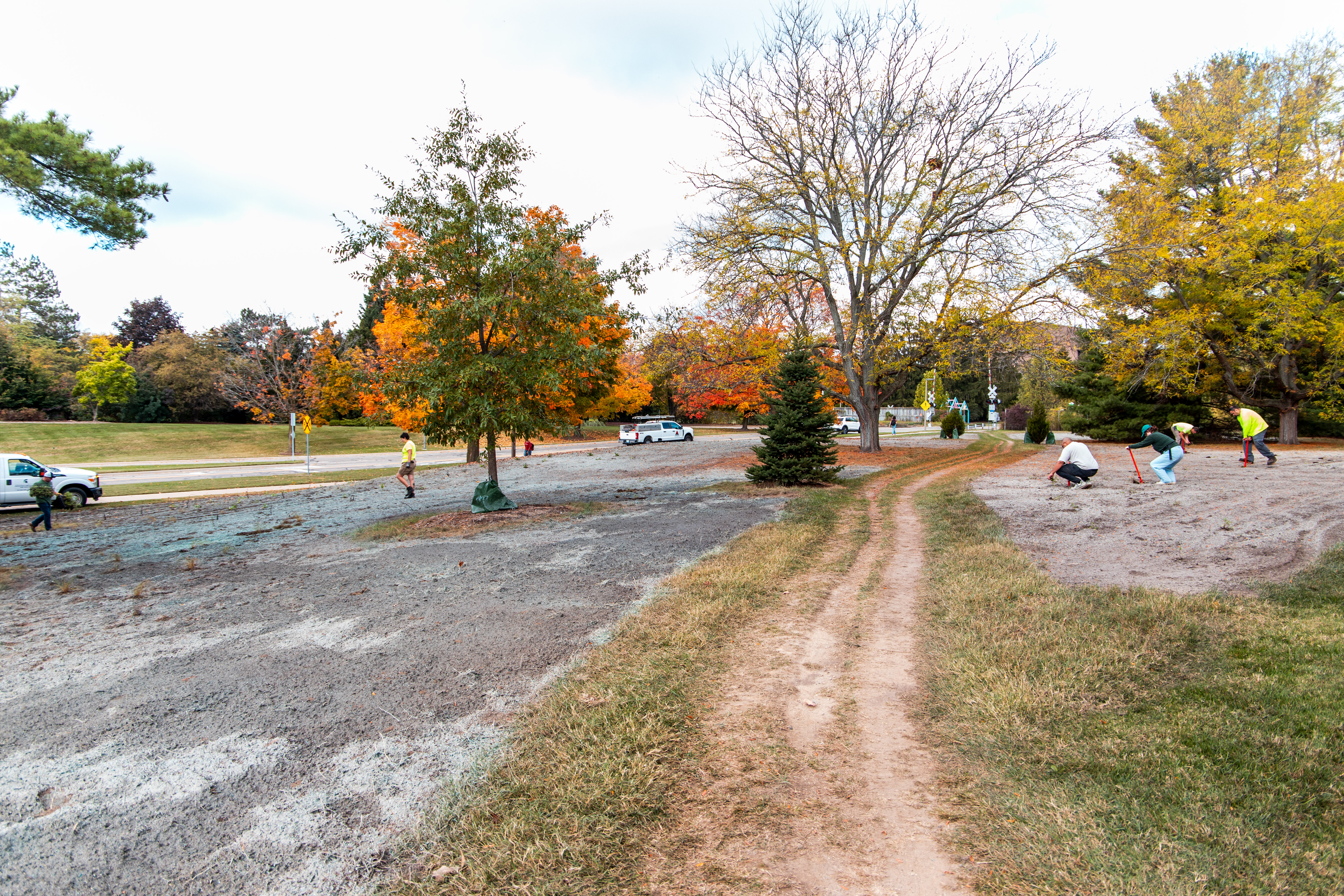
This large, high-traffic site retained a pedestrian path through it, requiring a more formal planting approach to maintain aesthetics and visibility. The dense plug installation also required three weeks of planting and large volunteer support.
Preparation & Installation
- Rotadairon pass
- Seeds applied, sown, and covered with hydromulch
- Dense plug installation
- No pesticides due to low weed pressure
Early Outcomes
The combination of good soil preparations, low weed pressure, and strong volunteer support led to successful establishment. The site had a more formal planting plan which provided immediate visual appeal.
Maintenance Plan
Because budget and labor cuts were major motivators for this project, minimizing maintenance was essential. Species were selected for their ability to establish in compacted soils, compete with weeds, and persist with limited intervention. Even so, the first few years will require targeted support while the plantings mature.
Maintenance will focus on three core tasks:
- Annual mowing to prevent encroachment and encourage seed dispersal
- Invasive species monitoring (three to four visits per growing season)
- Seed harvesting to sustain and expand habitat across campus
As the sites stabilize, intervention needs will decline, further reducing costs, resources, labor costs, and even environmental impacts such as carbon emissions.
Lessons Learned
- Timing matters
- Fall plantings established more reliably with fewer weed issues
- Early summer installations struggled with heat and weed pressure
- Soil preparation is crucial
- The Rotadairon created excellent seedbeds and loosened compacted soils, but can be time-intensive
- Herbicide + aeration was highly efficient in high-weed areas
- Weed pressure strongly influences success
- Sites with low weed pressure consistently thrived
- Aggressive pre-treatment may be necessary in some areas
- Plugs offer benefits and challenges
- Provide immediate visual appeal
- Required significant labor and sometimes shade housing + supplemental watering
Next Steps
In future projects, the Landscape Services team plans to:
- Prioritize fall installations
- Reduce plug quantities
- Incorporate strategic weed suppression where needed
- Expand seed harvesting and explore on-campus propagation
- Pilot clover mixes in solar lots and steep slopes where mowing poses safety concerns
A sign placed near the pollinator plantings. Photo courtesy of Sheila Babbit.